
Every time you click a link, your browser doesn’t magically receive a webpage from a server across the world. Something physical has to happen. Electrical signals have to move. Decisions have to be made. And an extraordinary set of engineering tricks developed over decades has to work perfectly, every single time.
This article tears open that cable and shows you exactly what’s going on inside it.
The Starting Point: Everything Is a 0 or a 1

Before we talk about cables, let’s talk about the problem we’re trying to solve.
In computing, all information text, images, videos, code is ultimately represented as bits: sequences of 0s and 1s. Your computer doesn’t think in words or pixels. It thinks in binary.
The fundamental challenge of internet communication is this: take a sequence of bits from one machine and deliver it, intact, to another machine — regardless of where in the world that machine is.
Simple to state. Wildly difficult to execute. Let’s see why.
Step 1 — Choosing a Physical Medium
To send bits from point A to point B, you need something physical to carry them. The most straightforward option? Take a copper wire, connect two computers with it, and use voltage changes to represent bits.
Here’s the basic idea:
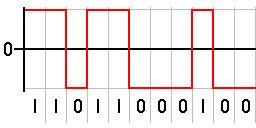
- To send a 1, the sending network card raises the voltage on the wire to +5V for a brief moment.
- To send a 0, it drops the voltage to -5V.
The receiving machine simply watches the voltage and reads the sequence.
This method is called NRZ encoding — Non-Return to Zero. It’s intuitive, efficient, and… deeply flawed.
Step 2 : The Hidden Problem With Simple Voltage Encoding
On paper, NRZ looks perfect. In practice, it hides a subtle but devastating problem: clock synchronization.
Every machine has its own internal clock a crystal that oscillates at a fixed frequency, ticking off time so the machine knows when to “read” the next bit. The sender and receiver each have their own clock, and those clocks are never perfectly synchronized. They’re close, but not identical.
For short transmissions, this doesn’t matter. But imagine the sender transmits a long string of identical bits say, ten consecutive 1s. The voltage stays at +5V the entire time, never changing. Now the receiver has no signal to “latch onto” to resynchronize its clock. And a tiny drift in clock speed accumulates over those 10 identical bits. The receiver might read 9 bits instead of 10, or 11 instead of 10.
This error is called a clock slip, and it silently corrupts data.
On varied bit sequences, this isn’t a problem the frequent voltage transitions give the receiver constant reference points to resynchronize. But long monotone sequences are a ticking time bomb.
There’s a second problem: DC balance. If the signal spends significantly more time at +5V than -5V (or vice versa), the average voltage across the cable drifts away from 0. That DC offset degrades the cable’s reliability over time and introduces random errors. Ideally, you want roughly equal numbers of 1s and 0s, keeping the average voltage near 0V.
Two problems. One clean solution? Not quite.