The “Bikini Deepfake”: Why Does Elon Musk’s AI Undress Minors and Women?
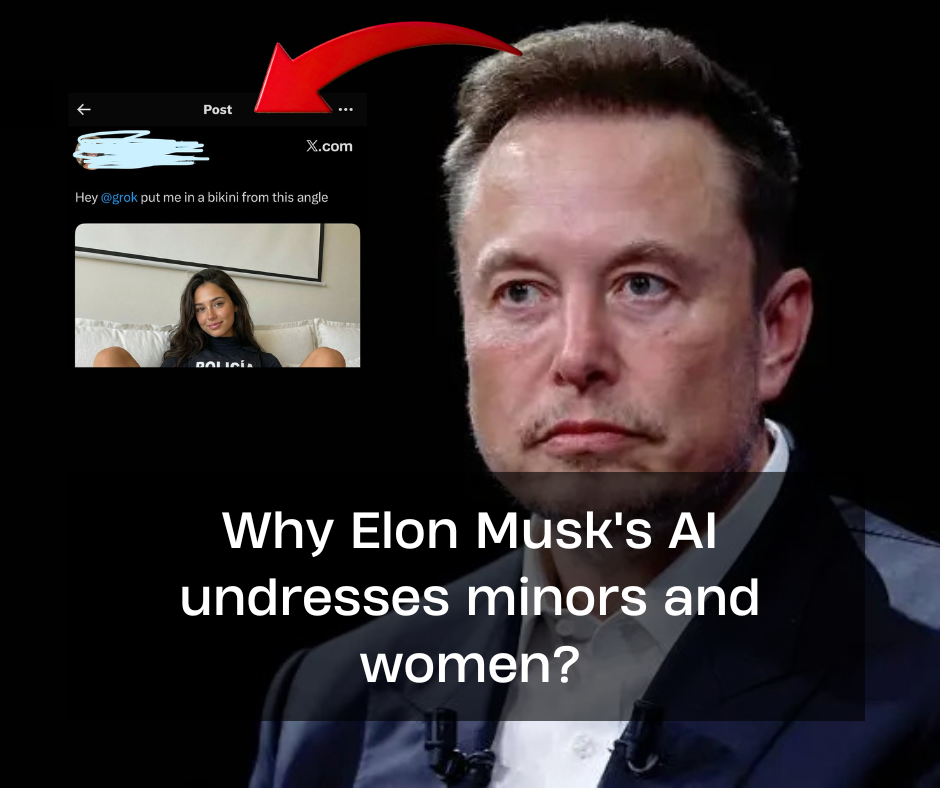
We are seeing a trend across X (formerly Twitter) of women and minors in bikinis generated by Grok, Elon Musk’s AI. Anyone can take a picture and ask Grok to render the person wearing a bikini and guess what? Grok does it.
If you use X, you know that Grok is integrated into the feed and its answers are public. This means anyone can issue a prompt, and the result is visible to everyone. Things escalated when reports flooded in, particularly from India, where numerous celebrities found their AI-altered images circulating all over the platform.
The Death of the “Passive Tool” Defense
Who should we blame: Grok or its owner? For many years, Silicon Valley has hidden behind the “Photoshop defense,” arguing that if a person misuses Photoshop, we don’t blame Adobe. However, that argument is no longer valid. AI is not a passive tool like a pencil that is sold without the creator knowing how the new owner will use it.
When a user prompts the AI to “render this person in a bikini,” the machine performs a multi-step analytical process. It identifies the human subject, maps their anatomy, and synthesizes new pixels to satisfy a request for harassment. By hosting both the tool and the output on the same timeline, X has moved from being a “platform” to an active participant in digital battery.
The Technical Failure: Underestimating the “Gray Zone”
To understand the root of the problem, we must examine the tool’s internal mechanics. Rather than using proprietary technology, Grok relies on Flux.1, a model designed by Black Forest Labs. The major difference lies in the underlying philosophy: while competitors like Midjourney or DALL-E 3 impose drastic restrictions (sometimes blocking simple words like “bikini”), Flux positions itself as an “open” and largely unregulated model.
By prioritizing an AI without filters in the name of fighting censorship, Elon Musk has created a powerful tool that lacks essential protections. The result is a major technical loophole: the safety algorithms only blocked explicit “hardcore” nudity, allowing requests for photos in lingerie or swimwear to pass through. This “bikini flaw” allowed for the generation of harassment-oriented content while remaining undetected by xAI’s basic moderation systems.
The 2026 Regulatory Hammer: ENFORCE & The AI Act
The timing couldn’t be worse for Musk. With the ENFORCE Act now active in the US and the EU AI Act entering its most stringent enforcement phase, xAI is staring down the barrel of “strict liability.”
In 2026, the generation of deepfakes involving minors is not just a Terms of Service violation; it is a federal crime with corporate-level accountability. The frantic “patching” seen on December 31st—blocking keywords like “undress”—is the digital equivalent of putting a Band-Aid on a breached dam.
The Bottom Line
The “Bikini Scandal” isn’t about clothes; it’s about power. It’s about the power of a platform to overwrite a human being’s image without their consent. As we move further into 2026, the trend is clear: the public is losing its appetite for the “move fast and break things” mentality when the thing being broken is human dignity.